Remember-Telling
Remember Telling
Grandmother always asks if I remember; never the other way around, never the opposite, where I get to question, quiz her. Never, as she shows me a picture—one of many—and asks if I remember. I say: yes, of course, how could you even ask? This is your backyard, I was ten or eleven, we are making wine with grandpa. She shows me another and asks again if I remember and I say: this was taken at a farm, we used to go swimming after seeing the animals.
She shows me a picture from her childhood, something I cannot remember because I was not there, in that place—an ocean away—or time. If I were, I’d be something like a reverse ghost, haunting grandmother before I was ever conceived. She tells me about the picture, who is in it, where it was taken, who took it, what had happened that day. She tells me these details not to challenge her own memory, but almost as if she wants me to experience it. Maybe she is telling me these little details so that the next time she shows me the picture and asks me if I remember, I can say: this was from when…
As we go through more stills, I am still when she tells me to write her story. I say I will, I will try, I will think of stories to tell; some I have already written, those important to me, that I was able to recall the quickest: grandmother and the window at school where I waved to her, inconsolable as she left to go back home and me trapped; grandmother and marbles, which my siblings and I lost, gained, and lost again until she found out and made us stop playing for keeps; more stories not yet written: grandmother and tango, how we used to dance together in her kitchen. Some stories I’ve written in essays and some in fiction because I don’t really see the difference in a story, the fiction being filled with actual events, the essays with liberties taken, imaginings captured.
Grandmother shows me a picture of her childhood home in Spain and asks me if I remember, and I say: this is your home, your old home, your home from when you were a kid. I remember telling grandmother details and we go on, through the day, in images. As we do, I think of more stories to tell, those I haven’t written yet, of her, her family, her husband, of places gone, of people gone.
Great-Grandfather Walked into a Bar
With a grenade, great-grandfather walked into his local bar. That’s how the story goes. He had either stolen or was given the grenade, I can only guess, his obtaining an explosive never being part of the tale. And so he walked into the bar, without malice, to show off the device or maybe to find its owner, this all during the Spanish Civil War, where I imagine it was easier to get access to grenades, and in an outburst, but not the bursting of a weapon, great-grandfather was taken away and temporarily imprisoned, though he would eventually be released, serving only a short sentence, because great-grandfather was a drunk, not a threat. This is the only story I have ever heard about great-grandfather.
Grandmother never spoke of him. When the topic arose, she avoided as much as possible until finally giving in, she recalled passing him bread through the bars of a makeshift holding cell near a church. My father would later attend school on the church grounds, and grandmother would pick him and his brother up after their lessons, and she would see where great-grandfather had once been, their fingers touching around bread, between bars. Was he a fascist? I asked my father. He responded; I remember him responding, but not his response, the word: a simple yes, a simple no.
Though their relationship became estranged, either before or after the grenade, great-grandfather still lived with his family. He occupied a tiny room near the front door, coming and going at all hours, as if a ghost occupied the space, he emerged at night, walked through the hallways, opened doors and cupboards, left, returned, returned as the sun was rising, staggering in, bumping into the walls, and disappearing, a ghost settling in, before anyone could make out a person, only a blur.
Where is father? One of grandmother’s sisters might have asked her as they heard a sudden noise in the next room, someone rummaging, coughing, sitting on a squeaky bed, and grandmother might have responded with, I’m not sure, but I can feel a presence nearby. And the spirit who lived with them, something like an expired father, lived out his days. I never heard how or when great-grandfather passed away.
Ghost Room
Grandmother’s house was haunted when I was child. There was a room she called “the ghost room” where some of my siblings would ultimately have to sleep when we stayed the night. When I was older I learned the house was old, the electrical needed to be replaced which caused items to turn on unexpectedly. Grandmother told me of a time when she was all alone and a stereo turned on beneath the house, in her cellar, music rising like heat, and her feet on the kitchen’s cool tile. She left the house. Presumably the music continued until someone went down into the cellar and grandmother would warn them, not of the ghost, but for them to watch their head as they made their descent.
How did grandmother get rid of her ghost? One day, as she tells it, she told the ghost off, said simply that she’d had enough and it was time to go. After that, there were no more encounters. Perhaps the ghost had gone into hibernation. It was winter after all. Grandmother still believes she can expel the supernatural. And who am I to doubt her?
In all the time I spent in that house I never saw a ghost, never asked why a ghost might appear, never experienced some unexplained phenomenon, was never electrocuted.
Caring for a Graveyard
Grandmother and grandfather, active members in their community, with weekly volunteer shifts at the senior center and local history museum, came to care for a graveyard. Mostly mowing, pruning, anything to clear away growth, I once found myself waist deep in a hole as my grandfather told me to keep going, to dig until I made contact. Apparently, the graveyard had been poorly mapped throughout the years, with some plots being lost, though how could any casket be truly lost if it was within the boundary of the cemetery, buried in the earth? I dug and dug, my brothers and I took turns in the hole, as my grandfather supervised, and then we met the coffin.
On a bright summer day, sweating before even holding a shovel, my twin brother looked uncomfortable, like we were doing something wrong, before we had even started digging. Just being in the cemetery made him more cautious than I ever expected. When we met the coffin, grandfather was surprised by its size, my twin brother looked concerned. We were in search of a different plot, an adult who had been buried nearby, all of this confirming what we had already known: the map was completely unreliable. And this smaller coffin, belonging to a child, grandfather informed us, that we had found, something like a discovery, though the child had been right here all along these past fifty or so years, would be added to a new map. But we weren’t done yet. We kept digging and eventually uncovered the burial we had intended to find. Grandfather, spry and lean as ever, jumped into the hole, feet on the burial liner—the concrete container holding the coffin within. The proximity to the casket and grandfather’s cavalier steps, made my twin brother go pale. Perhaps fearful of retribution, a cost of disturbance, knowing it best not to meddle, interfere, get in the way of a spirit, a ghost, a place meant to settle, for rest. I’m not sure what we were even doing, if we were removing the coffin to be relocated or adding another loved one to the plot. Grandfather never explained and we never thought to ask, merely dug as we had been instructed to do, until the sun began to set, and we went back home for dinner.
Grandfather passed away years later. Cancer found its way into his head. It was terrible, the treatment shriveling his body to skeletal, where he didn’t have the strength to rise from a chair. And then he went, the loss being both devastating and a relief. The funeral service was filled with what felt like the entire community. My sister spoke beautiful words, words for all of us, words I didn’t have then. I don’t remember what she said. I don’t remember where grandfather is buried.
Tunneler
Before he went away, he called without warning, without grandmother, asking if I was free, saying he could be at my place in ten minutes if only he had the address. Then grandfather was at my door.
It was strange, his appearance. Strange because I was only then realizing, with grandfather there, that we had never spent much time alone together. We’d go on the quick errand, to a bakery or a friend’s farm to pick fruit, always with a task at hand, but always with me as a visitor, always with grandmother nearby.
Grandfather at my door requested I take him somewhere, anywhere, and I agreed. I picked a spot, we set ourselves into the car and went.
On the way, he pointed out a building that once was or still was a hospital. He mentioned how he was a patient there for a period after an injury. I asked how he’d gotten hurt, but he couldn't remember. The conversation dropped off, down a hole we couldn’t descend, but we’re fine to let it go, a regular occurrence for us.
Soon we were there, a somewhere for grandfather. He parked and I led him to the lookout, the ruins of a historic pool against the ocean before us. We took a trail down and wandered the remains. We moved slowly. Spoke little. I wanted to ask grandfather what he was doing here, why he had come, and why alone, but before I could get the words out grandfather was pointing to a tunnel, a cave.
I told him how bands played music in the tunnel sometimes, how they’d carry a generator, all their instruments, how the noise could be overwhelming since the sound was forced to travel in only one direction.
Grandfather nodded, understanding with nothing to add.
As we walked towards the cave, I grew distracted by birds. I stopped and watched them rise and fall, everything seemingly within their reach.
I turned to grandfather to point out the birds, but he had gone ahead to the opening in the rock. I caught only a glimpse of him before he was lost from sight. I waited outside as people trickled in and out of the opening. They came and went, all except grandfather.
Eventually, when I started to fear grandfather may never emerge, I entered the cavernous space. I spotted him almost immediately at the far side, near another opening which fed into the water, where the ocean was allowed in, where the tunnel looked like a whale's mouth taking in the sea before expelling it.
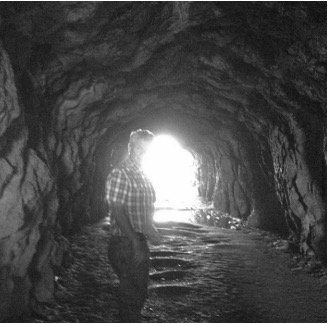
From where I stood, the light caught grandfather just so and half his body disappeared. Grandfather was cut in half in a tunnel. Taken away by light, by water, by a bird who took what was in their reach and fled to the sky.
Then grandfather returned, intact, and suggested we get root beer floats.
We sat at the counter of a restaurant up on the cliff, above the baths. Grandfather ordered and the next few minutes went by with the occasional back-and-forth about grandmother, the museum where they both volunteered, the cemetery, their garden and collective battle with tunnel dwellers.
The floats arrived and we settled back into our regular routine of quiet.
At some point grandfather told me he must leave, had to get home, had a long drive ahead. He offered me a ride, but I said I'd preferred to walk. We said goodbye. And that was it. Without a single question asked or an answer given.
*
Grandfather never told anyone about the time he came to see me. Not even grandmother. And why would he? And now grandmother lives in a new house far away from the one she shared with grandfather, the one which once held a ghost before grandmother dispelled it, maybe, and grandfather has gone even farther to a place I cannot visit easily or frequently so instead I went back to the ruined pool against the ocean. I headed straight for the tunnel without the distraction of birds. I entered and saw the whale mouth. I saw the light, easily capable of slicing one into two. I saw the half of grandfather that was cut from him the first and last time he visited. Half a grandfather in a tunnel. In a cave, I spoke, I asked grandfather all the questions I never posed, never seemed to get out, though they came often in his presence. As I did, I worried my words would be garbled by the ocean, that the water, coming in from the opening, would swallow up my voice, drown me out in ocean and tunnel, all of it something like a whale. I asked everything I ever wanted to know, where everything was in my reach.
A Tendency for Ghosts
I remember telling grandmother this story about grandfather, showing her the picture of grandfather cut in half by the light, in the cave. I remember telling grandmother that when I think about ghosts I have the tendency to think about her house, the one she lived in when we were kids, the one with grandfather. Even when I think about returning to the cave where grandpa was split in two, I think about your house, I remember telling grandmother. When I think going into the tunnel I am already at the end, where I look out through the whale mouth opening and instead of seeing the ocean, I see you and grandpa and me and my siblings in the backyard, playing, picking cherries and oranges off the trees, eating ham sandwiches and omelets in the shade, I see it as if I am a ghost, stories always seem to start there, even if the events were on another continent, in a room I have never been, about a person I’d never met; the story always originates there, where I’d first heard it. I remember grandmother telling me as I remember-tell it back to her, but only after I situate myself in her house, ready to listen.
There are stories I will forget, some great, some terrible, ones when grandmother worked in the cold place that stored produce plucked, pulled, pried, pushed from the earth or from a tree in the earth, and grandmother would be in the cold place, in the cold water, preparing the vegetables for cold storage. She shivered in the summer heat telling me about the cold, working with her friend Anita, another Spanish woman her age. She told me everything without pictures because who would take a picture of such a place, but as she spoke about it, I could picture it in my mind, until it became a memory of mine, one maybe not worth remembering, not when there were other things, more important things that had happened to grandmother in all her years worth remembering, but I remembered it, I remember though I don’t tell, not to her. What would be the point: to see her shiver?
We looked at more pictures of her old home—another ghost to us—when my twin brother mentioned one of his child’s recent soccer matches. He showed me a picture of grandmother and his kids. Everyone was laughing, but none more so than grandmother and her great-grandchildren. Someone must have told a joke or done something silly. I asked what happened and my twin told a story without ghosts.