A Review of Flat Earth by Anika Jade Levy
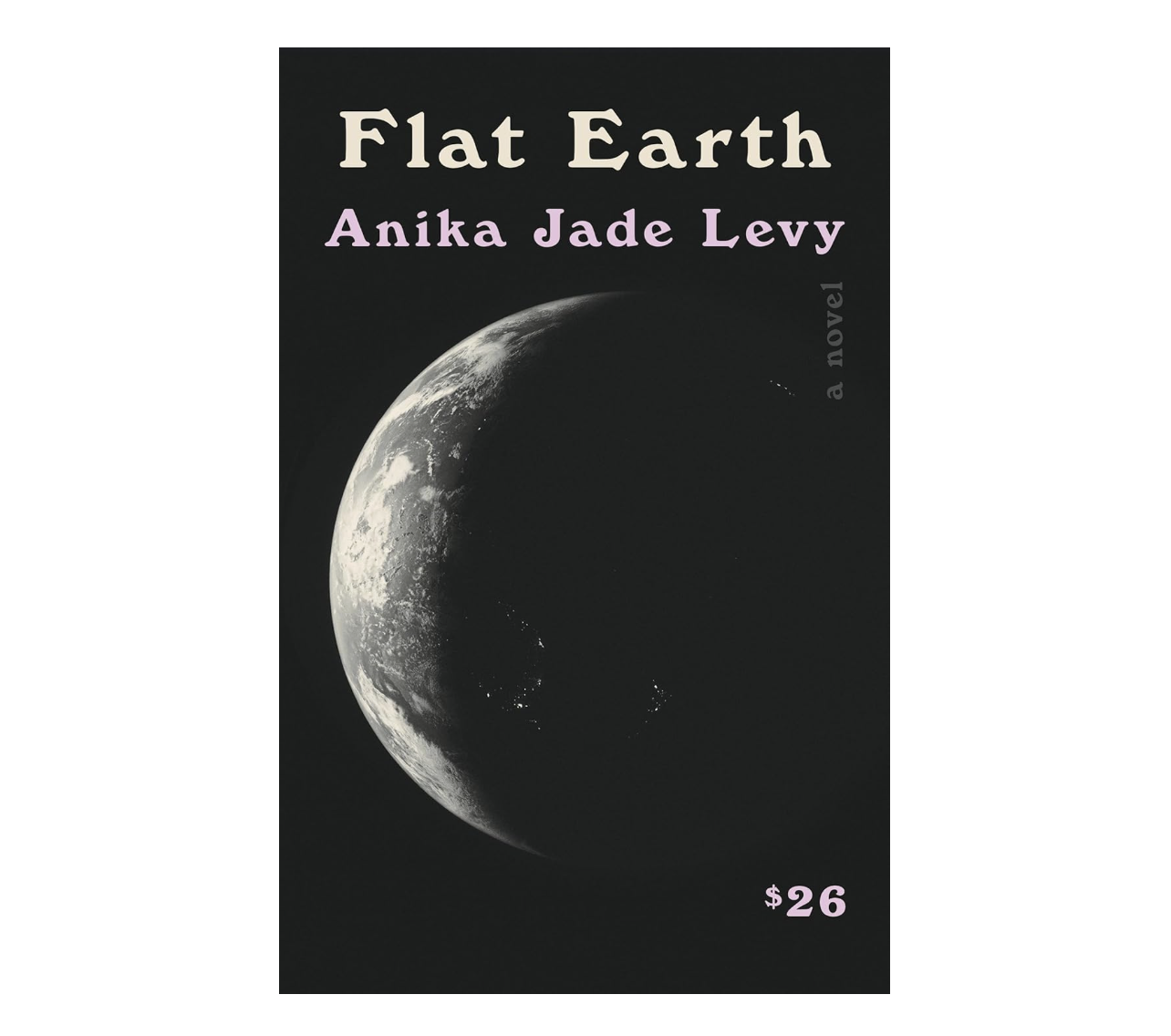
The apocalypse is a compost heap of Instagram ads, dating apps, cold punchlines and corporate malignancy in Flat Earth, Anika Jade Levy’s debut novel. Levy’s apocalyptic vision reassembles the haunted matter of contemporary American culture and makes it something nauseating and electric (both of which are compliments). Flat Earth reads like a frenetic, yet precisely calibrated, collage—reminiscent of Renata Adler’s Speedboat and Elizabeth Hardwick’s Sleepless Nights, particularly in Levy’s deft, sharp descriptions of New York, but there’s a unique pulse to the narrative that feels inimitable and distinctly of the 21st century.
“Everyone agrees that things have gone too far, but no one knows how to turn back,” so says Avery, the novel’s narrator, a young woman living—or trying to live, whatever that means mid-world’s-end—in New York City after getting a graduate degree in media studies. Much of the novel ostensibly focuses on Avery’s constant, jagged stream of sexual and romantic encounters with men, but I found that the most compelling and complicated relationships were the ones that involved other women. At the heart of the novel is Avery’s tense, consuming obsession with her close friend Frances, whom she first met in grad school. Frances is an aspiring experimental filmmaker and comes from the kind of glossy Southern old money that enables her to pursue such a career under the performance of precarity more than any actual risk-taking.
Many of my favorite novels involve some sort of thorny, tangled, intimate and ambiguous relationship between women. The homoerotic-girl-best-friendship narrative dynamic is one that never fails to engage me, and Levy manages to poke and prod at the contours of such an intimacy with a unique style melding droll spot-on satire and surprising cracks of vulnerability.
How can anyone formalize late capitalist malaise? The question itself sounds like a satirization of a question—one that I’m sure Frances or Avery would reiterate and/or mock—but I also sincerely think that Flat Earth is taking the cognitive dissonance and the everyday, naturalized transactionality of American daily life and turning it into its own narrative and stylistic form. While reading, I was struck by the fact that I could never quite discern when Avery was being sincere and when she was parodying the very idea of sincerity, and this ambiguity felt deliberately and skillfully designed to upend the reader’s expectations of any emotional transparency. When late capitalism has yanked us so far from our own capacities for feeling and estranged us from our own subjectivities in favor of ceaseless transactionality, when the cultural push towards relentless irony has swallowed anything resembling earnestness, when even our most private selves and lives only exist to be aestheticized and repackaged as buyable content, how can any narrator but the “unreliable” one exist, anyways?
I am generally put off by the recent-ish trend of literary fiction that over-depends on the very qualities that compose a lot of Flat Earth, at least on its surface: drollness, irony, the performance of emotional estrangement, a flattened voice, and a general assumption of normative white femininity’s depths and recesses. But Levy’s handling of these qualities is spectacularly clever and structured in such a way that it never feels arbitrary or tired. Some recent popular literary fiction feels like a thinned regurgitation of Ottessa Moshfegh sans everything that makes her work—in my humble opinion—richly textured and interesting. Levy, on the other hand, takes pastiche and sharpens it into an intriguing and nuanced, emotionally volatile structure. In doing so, Flat Earth ingenuously becomes a sort of funhouse mirror for the nightmare of “Modern American Womanhood,” which is of course a script and a myth in itself. Avery, at one point, takes a job as a copywriter at a right-wing dating app that is literally, unsubtly, called “Patriarchy.” There’s nothing unsubtle about the way patriarchy has revived and re-stylized itself via the algorithm, via tradwives and TikTok, via eugenicist white femininity beauty rituals, via the overhaul of reproductive rights protections, and so the choice to be so blunt about it feels scathingly appropriate in Flat Earth.
I think of Lauren Berlant’s words in Desire/Love: “Desire visits you as an impact from the outside, and yet, inducing an encounter with your affects, makes you feel as though it comes from within you; this means that your objects are not objective, but things and scenes that you have converted into propping up your world, and so what seems objective and autonomous in them is partly what your desire has created and therefore is a mirage, a shaky anchor.”
Levy amplifies and satirizes the transactionality that can seem to undergird every and all heterosexual relationships and the general experience of women who date men. What’s most interesting to me is how Avery’s interests in men are all actually about her central interest in Frances. But what’s tragic, and very real, too, is the fact that the transactionality that characterizes heterosexuality here inflects even the relationships between women. Avery relates to other women through the commodified, competitive value system that she’s been conditioned to accept as the only real or sustainable form of relationality. This poignant fact feels like Flat Earth’s most effective and compelling narrative point: how can Avery imagine a way of relating that doesn’t involve the transfer of herself as capital, as currency? How does anyone?
Flat Earth by Anika Jady Levy
Catapult Books, 2025. 224 pages. $26 hardcover.