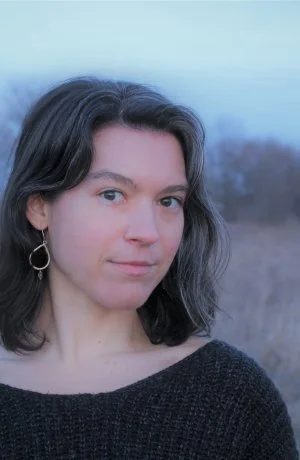
Loosening Language through the Video Essay: An Interview with Sarah Minor
In Harry Dodge’s My Meteorite: Or, Without the Random There Can Be No New Thing, he parses through the perks and pitfalls of language. “Language is neither absolutely successful,” he writes, “nor is it always failing (to represent)...As Franco Berardi has written about the genesis of modern poetry, So the word and the senses started to invent a new world of their own, rather than reflect or reproduce existing reality” (260). Video essays straddle a similar liminal space where the word, the senses, and the image start to foment new, and concurrent, visible and written grammars. Over the past ten years, interdisciplinary artist and writer Sarah Minor has been a key figure in the literary arts scene for defining, expanding, and challenging what video essays can do or be. Previously the Video Editor at TriQuarterly from 2016 to 2024, she now serves as the Video Essay Editor at Brink, a hybrid literary magazine based out of Iowa City. Minor is also an Assistant Professor in the Creative Nonfiction program at the University of Iowa and the author of Bright Archive (2020), Slim Confessions: The Universe as a Spider or Spit (2021), and the forthcoming Carousel (2026) from Yale University Press.
Hannah Bonner: Can you talk about when you were first exposed to or became interested in video essays?
Sarah Minor: The easy answer is that I encountered the term “video essay” through the work that was happening at DIAGRAM and being curated by Ander Monson, as well as on Essay Daily where Monson had invited me to start an interview series with makers of what I was calling “the visual essay” in its most capacious sense. I was talking to graphic memorists, people working in interactive texts, and book artists who really didn’t think of themselves as writers, etc. Through that series, I began to come across people working with video and text.
Later, when I studied with Eric LeMay at Ohio University I learned that he was really interested in audio essays. John Bresland had moved from defining and working with the video essay to also thinking about the audio essay and the history of the radio drama. Their work exposed me to other media that was seeking to do exactly what the essay could accomplish in digital formats off the page.
Something I also bring to my understanding of what a video essay is today is having been born a Millennial and having spent a lot of time on the internet where long before TikTok I encountered many types of short videos online. I’m thinking of looping clips embedded in Tumblr that might include text, or a soundtrack that could be categorized as a kind of internet art that, like ASCII art, would go on to influence the kind of work I would make as a writer.
HB: It sounds like your initial, primary focus was on video essays and their literary histories. When did you become introduced to the concept of video essays and their cinematic histories?
SM: I was never a student of film, and it didn’t occur to me until much later that video essays are also a genre practiced and discussed in film studies and by filmmakers. When John Bresland wrote about the film San Soleil (1983) as a video essay, I realized there was this whole other range I hadn’t yet explored that wasn’t experimental video art, that wasn’t an iPhone held out a car window by a poet, but something that thought about how moving image could do what writers were trying to do on the page.
HB: You took over as the video essays editor at TriQuarterly in 2016 after Kristen Radtke and really pushed the video essay genre to the forefront of the publication. What were your goals when you took on that editorial role at the magazine and how did they evolve during your tenure?
SM: I got really interested in what other people thought video essays were by looking at TriQuarterly’s slush pile. We had video artists submitting work that had little or no text, we were seeing home videos and recordings of poetry readings or poets simply recording themselves reading a poem. All of those didn’t quite feel like what we were looking for. So when I took on the role of editor, I began looking for work that would have, at the time, been called “experimental” even on the page.
I wanted to be open, too, to find video work that didn’t necessarily have a through-narrative. I was interested in literary videos featuring the kind of text that could stand alone if the video was divorced from it. I wanted texts that needed, and were spurred by, the moving image.
HB: What’s your approach to curating video essays for a publication?
SM: I love to include videos that self-identify as a cinepoem, videos that self-identify as a video essay, and something that doesn’t identify itself at all, that is out of category. I also like to vary the type of moving images that are included. So maybe one would be a very low-fi clip of someone moving drawings in front of a camera, then another might be someone trained in cinema taking footage of a landscape, and maybe another would be text manipulated onscreen. So I am interested in curation as a demonstration of variety.
HB: You’re the inaugural video essay editor at Brink. What are you currently looking for in video essays?
SM: I’m still interested in low-skill image making, like hand drawing or people working with figures in front of the camera. But I’m no longer interested in video essays where a camera is pointed at the ground as someone narrates the journey. I’ve seen a lot of home videos with text pasted over it, but I’d love to see that done a little differently and be surprised by invigorated versions of that form. Diana Koi Nguyen is doing work that does that for me.
I love videos like Instar by Jessie Kraemer , a film that is very quiet–it’s two people having a phone conversation. The video essay is very prose-like, it’s essentially a monologue. It’s a propulsive illustration of someone listening and someone speaking, someone passive and someone active in ways we might not expect. There are a lot of skills at work behind the camera and on the page, but they’re contributing very different qualities to the project.
HB: There can be a divide in literary spheres that video essays must include text or voice-over. What’s your stance? Why?
SM: For a long time, I was working in places where people were really interested in seeing text on screen. These were folks interested in either reading captions or hearing a narrative voice over. But I’m really excited by cinepoems and video essays that do something other than that. Text doesn’t necessarily have to be visible in a video essay, it can be contributing a kind of texture, and the images can be more plot based. Maybe the language is even slightly inaudible, contributing something more like a character as it does in Ryley O’Byrne’s Liturgies.
The thing I hold onto is that I think a video essay should contain some form of language, but that language can be very loosely defined. Sometimes I like to call video essays “literary video” because I think video can do what writers are seeking to accomplish, but language is not necessarily always central to that outcome.