Review of Time Also Will Make it Interesting: Selected Journals
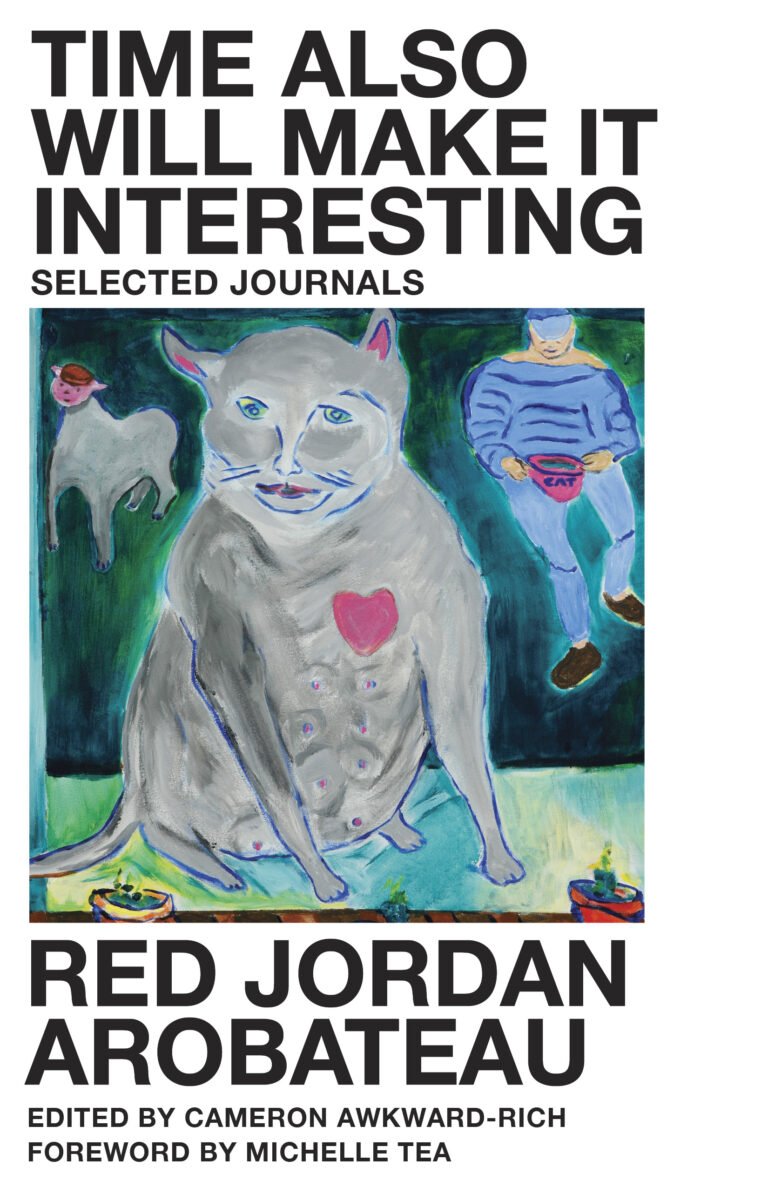
Red Jordan Arobateau was his own publishing machine. Though he died in 2021, his page on the print-on-demand site Lulu still offers up 287 books of self-published autofiction, erotica, poetry, and journals. It’s an immaculate record of his writing life that makes it nearly impossible to know where to start with his work. While only a handful of his books were formally published in his lifetime, Arobateau isn’t exactly a lost figure. Throughout queer and trans writing scenes and his home in the Bay, Arobateau was notorious and present, making the kinds of books that weren’t readily on offer: stories about black dykes and dykes of color, gender non-conforming and trans people, poverty, police brutality, and—always—sex. Arobateau influenced writers across many generations, evidenced by Michelle Tea’s devotional but honest introduction to Time Also Will Make It Interesting, the first publisher-issued edition of Arobateau’s journals. Arobateau wrote marginalized queer existence in vivid detail, voicing its violent conditions as much as its otherworldly pleasure. His compulsive relationship to writing stretched from gay liberation’s first promises to its ugly 21st century disappointments.
In his recent essay “Writing Through the Middle,” poet-scholar and Time Also Will Make It Interesting editor Cameron Awkward-Rich turned Arobateau’s unending bibliography into a theory of “the middle.” It’s a theory that both acknowledges the impossibility of ever getting to the end of such a prolific oeuvre and celebrates Arobateau’s journaling practice for refusing the closure and finality of autobiography, a genre that haunts trans literature. In a necessary project of preservation and access, Awkward-Rich pulled from twenty years of Arobateau’s diaries to construct Time Also Will Make It Interesting. Arobateau’s entries skip erratically through time, writing history as a recursive collage. Together the journals record a lifetime of challenges and successes in artmaking while navigating poverty, transition, and a rapidly changing San Francisco. They are immaculate documents of erotic dailiness and willful self-articulation that function, too, as histories of Arobateau’s early butch/femme and 80s, 90s, and 00s trans Bay Area communities. Whether making art or getting off, readers see the fantasy and drive that kept Arobateau’s work circulating through the world.
Time Also Will Make It Interesting collects excerpts from over thirty of Arobateau’s self-published journals, the full books permanently stored in Arobateau’s papers at the Transgender Archives at University of Victoria (or available for purchase on Lulu). While a few of Arobateau’s smut novels were picked up by 90s gay paperback press Masquerade Books, his extensive output and lack of publication offers led to a self-publishing endeavor that demonstrated the total determination that willed his writing into print. By the 90s, Red Jordan Press sent out a mail order catalog of 30-odd books authored by Arobateau, each issued as spiral-bound photocopy mailed from Oakland. “These works prove that the xerox machine probably did as much for gay and lesbian sexuality as did Stonewall,” wrote Marcy Sheiner in a 1994 issue of San Francisco lez mag Dykespeak. Arobateau felt burned by the elitism and prudishness of feminist lesbian publishing—only the straight male editor at Masquerade was willing to release his books. In a 1996 essay for the short-lived Lesbian Review of Books, Arobateau wrote, “I have suffered one of the most insidious forms of abuse of all—to be overlooked—for half a lifetime.”
Awkward-Rich emphasizes Arobateau’s phrase “the abject bottom” as the place-status he occupied, though Arobateau’s ostracization seemed only to intensify his need to share stories from this point of view. A realist—honest but not cynical—Arobateau’s journals depict the difficulty of making art with neither compensation nor publisher support. Writing between genres—an experiment chronicled by Awkward-Rich in his introduction—Arobateau takes up a hybrid “journoval” form in retracing his history. He often becomes a character in his own recollections but the gesture feels more about making meaning than creating distance. “Transman has a herstory,” he writes at one point, threading his butch and trans experiences, his writing marked by a fidelity to the complications and communities—or lack thereof—that brought him to the present moment (57). In Arobateau’s journals, each part of his life swirls together, reenacted and examined as if experiencing for the first time.
Arobateau’s sexual fantasies are the glue between hard times and artistic epiphanies. These records of sexual exchange sometimes read like grocery lists and other times sprawl into hallucinated poetry. For Arobateau, sex is a good feeling, social scene, hobby, and site of liberation. He writes, “Sex is a form of mastery in a world where he masters nothing” (69). Pleasure makes life more possible and there is so much pleasure that life feels limitless. For Arobateau, jerking off is as common as having a meal. It’s almost a relief—to read so much queer sex that it finally becomes uneventful. Arobateau is as present in his body as he is in the world. He chronicles poverty, antiblackness, transphobia, environmental devastation, and the mass death and corporate greed of war (he calls it the U$A). There is as much poetry as personal finance. For all writers who have lived without resources, it is the familiar math of trying to stay alive, living off the so-much-more of language in the meantime.
Arobateau’s work had an alluring way of dealing with the shit odds of the present. Years later, it reaches out into ours. “So, in the meantime, we all sit on a precarious fault line leading to the future,” Arobateau writes. He continues:
The goal? To create as much art as I can, despite semi-depression or financial straits, or lack of ‘connections’ before death or abandonment on some poverty ward. Like Bozo Texino, who tagged every boxcar which came under his jurisdiction at the railroad yard…in a desperate effort to make my mark in life, to help dislodge this impure Empire from its position of greed & war and inform the public about all which I know. (250)
Arobateau corrected the violence of poverty, erasure, and lack of opportunities by leaving a trace everywhere he could. He found source material in all aspects of life, his journals and novels both resourcefully piling up everything around him. In “Writing Through the Middle,” Awkward-Rich depicts Arobateau as “something of a scavenger: he made use of whatever he could find.” Reading Arobateau’s journals, one sees this process unfolding, an endless series of ideas and questions and ways of remembering that act as a greased motor.
In airing his grievances to the Lesbian Review of Books—many of which were also aimed at the publication and its editors—Arobateau also offered a beautiful biographical statement: “I am a witness on the sea of life. I’ve been a part of our gay world for all these years. I lived The Life and wrote down everything I saw.” Through the attentive editorial work of Cameron Awkward-Rich, Time Also Will Make it Interesting brings Arobateau’s everyday histories back out into the world, reminding us of the often-lost sexual undercurrent of gay liberation. These journals are a first step in recovering and making accessible Arobateau’s work. For a new generation looking to get their bearings inside Arobateau’s catalog, they offer a necessary entry point. In the awful present, we might hold tight to a few lessons from Red Jordan Arobateau—to let the erotic soul have its proper frame, to saturate the world with art, and to let pleasure be reason enough to keep going.
Arobateau, Red Jordan. "The Real Red Jordan Arobateau." The Lesbian Review of Books, vol.
2, no. 3, spring 1996.
Arobateau, Red Jordan. Time Also Will Make It Interesting: Selected Journals. Edited by
Cameron Awkward-Rich, Nightboat Books, 2026.
Awkward-Rich, Cameron. "Writing Through the Middle: Dispatches from the Journals of Red
Jordan Arobateau." College Literature, vol. 52 no. 4, 2025, pp. 636-660.
Sheiner, Marcy. "Books from the War Zone." Dykespeak, Aug. 1994, p. 19.