“Death does not kill relation”: A Review of Aracelis Girmay’s Green of All Heads
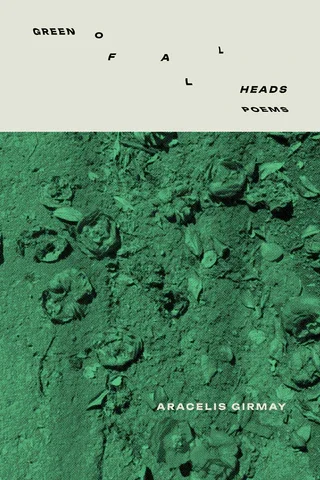
Aracelis Girmay’s stunning new collection Green of All Heads opens: “Or that I would run my hand along.” Here, the reader is suspended before an action, where divergent paths emerge. “Or” is a conjunction, used to indicate an alternative (“Would you like cream or sugar?”) or uncertainty (“We’ll be there at 2 or 2:30.”). Here in the opening poem, “December,” the word could function as either a conjunction, an indicative, or both. The speaker could run their hand along, or they could not—no, not a could, not a possibility. The question is not whether the speaker can reach out, but whether they will. Still, who or what might they reach out to? Enjambment breaks the line, leaving the reader hovering in an undefined space, much like “or.”
If the preceding paragraph wasn’t indicative, lately I’ve been obsessed with the opening poems of books. “December” is especially provocative because it acts as an epigraph. Green of All Heads is divided into five sections; while the first section and third section have epigraphs, “December” stands before and apart from them. The poem, as epigraphs do, previews and contextualizes the collection’s following poems against itself, tonally and thematically, overturing this collection. Here, we see many of the collection’s swirling preoccupations: belonging/not belonging, family, memory, knowing/not knowing, life after the death of a loved one. We might summarize this as proximity: distance and closeness from each other, from communities, from history, from the self, from knowledge, from childhood, from living itself.
Girmay continues “December” with:
the dip in the hill’s grey back
up to its withers, feeling
the closeness of its heat,
its inwardness risen and risen and
blown away
This exceeds physical proximity into a spiritual one. The blurring of boundaries between landscape and horse establishes Girmay’s repetitive insistence of existence’s porous nature, depicting a world where boundaries between humans, animals, and life and death are flexible. In the later poem, “Ceremony for Remembering the Doorless World,” Girmay writes “three we-horses mark ground, / turn snake our necks inside the guayla circle.” In Green of All Heads, things do not become like each other; there is no transformation. It is more that they are already blurred, already a part of everything else.
Later in “December,” Girmay writes, “Uncle is, swishing away the flies / Mother is, pouring black coffee through their hair.” Forgive me for delving into close reading again, but the commas are doing so much work here. They divide what would be a complete sentence, adding a pause. “Uncle is” and “Mother is,” are gesturing toward existence; it is a naming of their presence. Only afterwards do the lines move into action.
In the mother line, Girmay begins a playfulness with pronouns that take fuller shape later in the collection with the line “pouring black coffee through their hair.” The pronoun is a jolt, “them” instead of the more predictable “her.” It turns the action communal, removing separation. It also casts the uncle’s line as potentially communal; he is not just swishing away the flies from himself, but also the mother, and anyone else who is included in “their.”
Girmay continues: “Each of us, briefly, a tense / cast into the other’s time.” People are not cast—as a propulsive verb or as an actor— among each other, but “into the other’s time.” This proximity persists even after death. As she writes in “For A,” “Death does not kill relation.” To me, that line is the pounding heart of the collection, a summation of the agony that is the death of a loved one. A person dies, but who they were to others continues.
“Ceremony for Remembering the Doorless World” merges this sense of proximity beyond death with the porous nature of existence to create a world of dissolution between people, stretching across life and death:
—so when I listen I
still hear you still kicking the ball,
laughing as you say the story of endurance…
so we are three & simultaneous earths inside
your coil of fatherhair to which I press my ear to hear
the histories
The images of father, speaker, and son collapse into and against each other. Language itself seems to collapse as I try to dissect this poem; It is so diffuse that it lives as a whole.
Green of All Heads is also concerned with distance; the divisions of individuals and life and death do exist. “Your Words Again” is one of the most unique poems I’ve read in a while. Structured as a play, it begins with a dramatis personae, a stage diagram, and stage directions. The dramatis personae surfaces the communal, breaking the poem out of the lyric “I.”
Meanwhile, the stage directions begin: “K enters through the side of the dead with a basket of clothes to dry. One by one, she / hangs each item on the line with clothespins, straight down the middle of the field. / Pants, shirts, a dress. She stays on the side of the dead, careful not to touch the other / side.” Here, K creates a physical barrier between life and death. Yet, the delineation of the worlds is not solid. There are shifting spaces to reach through.
“Z” enters on the side of the living. Z—the last letter of the alphabet, the last one alive—struggles to communicate with the deceased through the clothes, which Girmay also depicts as a bad radio connection. Z says, “Or when I was pregnant, was one of you the opossum who / looked at me through the leaves? I just remember thinking that after you died that death was a problem to be solved, a threshold to withstand. As though it were something that could end.”
The porous nature of Girmay’s world, sprawling between and through life and death, does not portray an easy communication with the deceased. Instead, we strain, we grasp at what may only be shadows in the aftermath of immeasurable loss. Green of All Heads is not a collection of revelation, or a shining light that brings definitive answers, but one that questions, listens, reaches out, tries to get close enough, to maybe “run my hand along.”
Green of All Heads by Aracelis Girmay
BOA Editions, 2025. 130 pages. $19.00, trade paperback.