A Review of Adedayo Agarau’s The Years of Blood
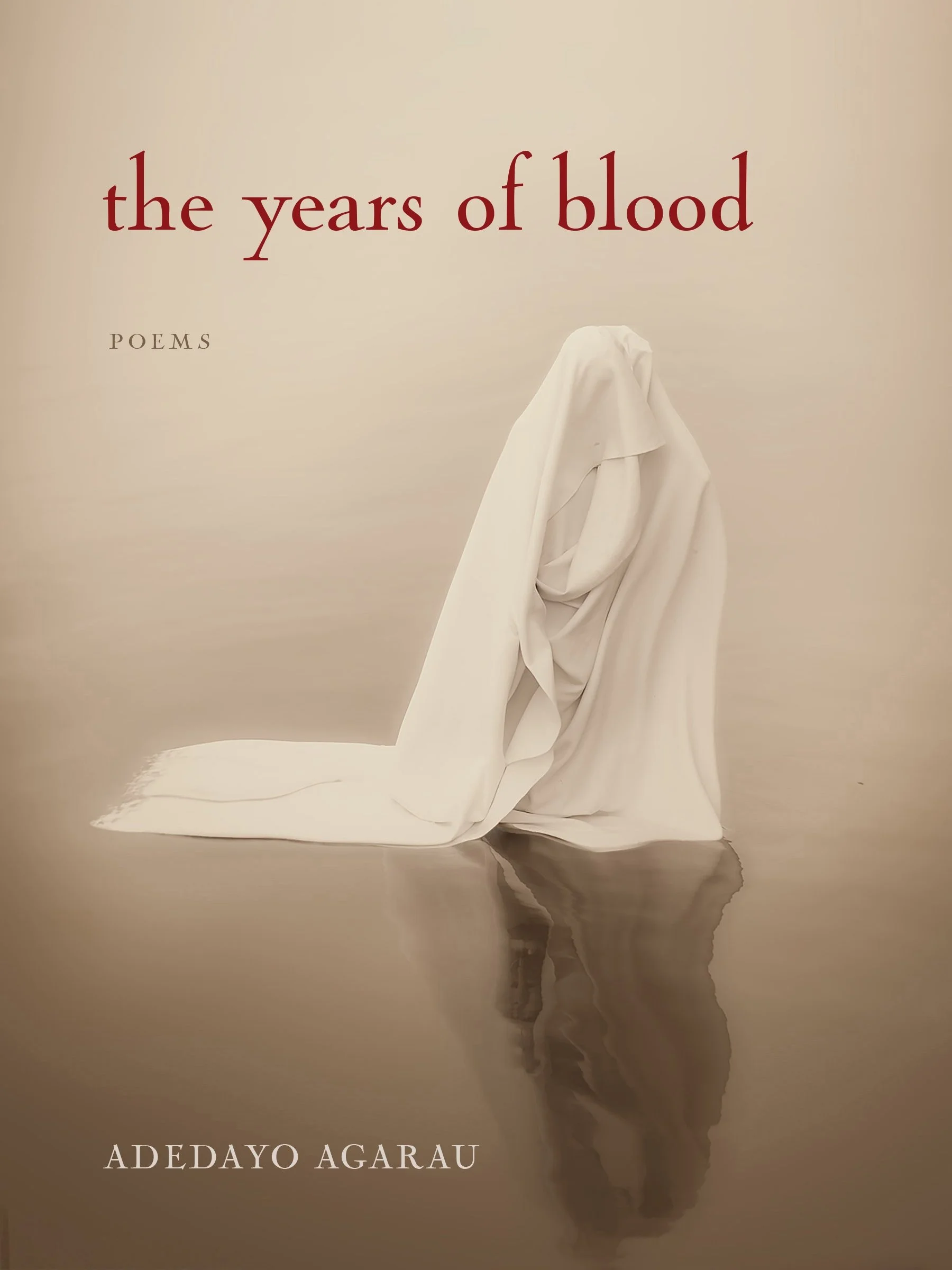
In Adedayo Agarau’s debut collection The Years of Blood, when are the years not of blood? Though more overtly alluding to the bloodshed that has resulted from Nigerian ritual killings—in which the mutilated body is believed to transmute into material wealth—there is another major register blood occupies in this collection: that of blood ties, of being family.
Writing from the nexus of personal and political histories, Agarau’s poems ask not only what we must make of blood that has been spilt, but also its relationship to that which has not been and continues to course through our veins.
The spilling of blood is the rupture of family. For every child lost to ritual murder, there is “the hollowed throat of the mother panting for her son.” Blood externalized is that which is irrecoverable, even if for Agarau there is a last point of contact: hands “soaked” in blood. There is a play here on the idiom, to have blood on one’s hands, for who is guilty and how can one indict a whole system of beliefs?
In Agarau’s book, we are often at the scene of the crime. His poems reconstruct forensically the actions that led to the bodies before the bereaved. But the perpetrators are largely unidentified. Bodies are found dismembered or in the process of dismemberment,
“…a man pouring
incantations over her lifeless body
another slicing her breasts into a bowl”
while the mutilators are ambiguous, barely described, as indexes of a composite that is never given. The murderer is no particular person because it is a cultural ideology. One that authorizes atrocity.
The main particulars the reader encounters are victims such as Bámisé Tóyòsí Àyánwolé and the grievers, which Agarau counts himself among. This is what The Years of Blood repeatedly stages. The swing between the singular and the plural, the subject who finds in his own blood the multiplicity of lineage, a people, and even nationhood.
“what do I know of the blood / that flows through me?” Agarau asks in “It begins with gratitude & ends in rage.” It is a question of ancestry, of his name: Adedayo, a “Yoruba name given to sons of royal descent.” Blood is a question of inheritance—but what has been inherited? The etiology of ritual murder can be traced to precolonial practices and present-day materialism, so then how might one disinherit these? There is a doubling in poems like “Sókà.” Blood from broken flesh marks a break in progeneration, the end of a line. How instead of this to end the line of thinking that leads to violence?
Questions like these are what Agarau’s collection asks through his juxtapositions. The Years of Blood is coherent and calculated. Images recur and take on new shapes. Lines are picked clean as bones of clutter. There’s a clinical precision to his articulations. What he has to say is as much in his poems as it is in the spaces between them. The spaces carry the weight of ellipsis, the “aftermath of [silence]…” It is into this unspoken “after” that the book writes, where dreamless sleep occurs.
His poems are filled with dreams: “the hawk’s dream,” “the dream where i am gasping for air,” “the dream where my father kneels before the gods of doors.” An oneiric logic of reversals and transpositions riddles his writing: “darkness is fetched by the disappearance of light.” The night figures large throughout. He straddles the border between vigil and nightmare. The reader is left asking where dawn is for the speaker. The book refuses to answer. Instead, it enacts one more reversal in the concluding “Litany.” The nightmare is living, and it ends when “We all go to sleep.”
The Years of Blood by Adedayo Agarau
Fordham University Press, 2025. 97 pages. $18.99 paperback